
Support systems
MD Anderson Cancer Center
Problems
Perceived problem
- Safety and security of patients and caregivers is the biggest problem they experience when in the hospital.
Reframed problems
- MD Anderson has a premium position as the #1 clinical cancer care. However, we’ve heard from our patients + caregivers that we’re failing in providing positive experiences prior to + after meeting their clinical teams.
- Patients ask for high-touch support to navigate their end-to-end personalized care, mostly at transition points. Yet a human-only personal care navigation provided by a singular expert is challenging due to cost, skills, and scalability.
Challenges
- How do we re-imagine the way that MD Anderson increases care quality beyond clinical, across patients’ end-to-end care experience?
- How might we provide patients with scalable care navigation from pre-diagnosis through ongoing, while at the hospital, home, + other.
- How might we increase patients’ care quality + the number of patients receiving all their care at MD Anderson?
.
Solutions
- Human-technology personalized support system to support, inform, + anticipate patients’ + caregivers’ needs, especially at key transition points.
Results
This initiative instigated, informed and supported 9 initiatives including:
- Launched a nurse navigation program that improved patient and caregiver satisfaction
- Piloted a remote care strategy to expand access
- Created a virtual first-visit model, now scaling across departments
- Expanded food offerings with a plant-based menu across all facilities

Focus on patients’ needs
across their end-to-end
experience.
To ensure that we’re solving the problems that matter most + ensuring long-term impact, we:
- Conducted qualitative research with patients, caregivers, patients-facing employees + stakeholders to uncover insights.
- Facilitated workshops to generate as many ideas as possible to co-solve problems.
- Developed patients’ + caregivers’ archetypes.
- Co-mapped patients’ + caregivers’ current + future experience maps to visualize their experiences + uncover short / long-term opportunities.

Signals of change
To anticipate change we:
- Scanned signals of change key in health + beyond to understand the drivers of change affecting the patients’ + caregivers’ experiences.
- Mapped current MDA initiatives to map current ‘knowledge banks’ across silos.
- Created a framework for designing with stress in mind as we learned that cancer patients’ + caregivers’ stress levels impacts everything.
- Examined the history of welcome experiences to be aware of cyclical themes.

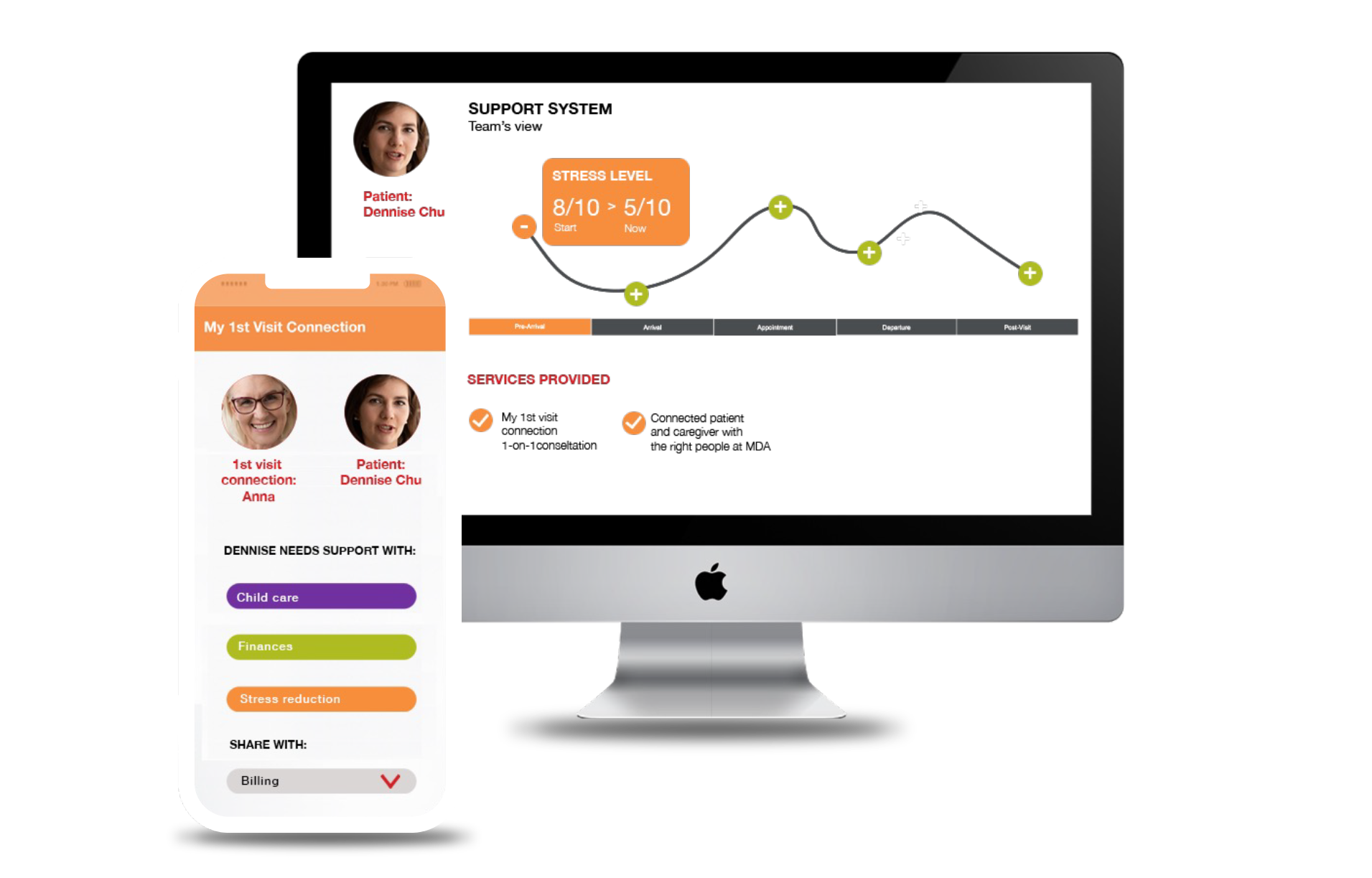
1. 1st Visit Connection.
- Patients can get 1-on-1, remote, authentic, insights from current/recent patients to prepare for their 1st visit.
- Offered while patients wait for their 1st visit, when their stress levels are particularly high.
- Patients are automatically matched based on their preferences + data provided prior to arrival.
- Tapping into current/recent patients’ desire to share + new patients’ need for early information.

Anticipating personalized
needs beyond clinical
- The 1st Visit Connection gains deep insights on patient needs + shares information automatically with the right resources at MD Anderson + beyond for patients to receive a personalized experience prior to + upon arrival.
- When needed, patients are connected in real time with the right knowledge + resources.

2. Patient Partner
- A service for patients arriving alone to MD Anderson without a caregiver, or when their caregiver can’t fully support them, especially in their 1st visit + challenging touch points.
- A Patient Partner may not fully replace a caregiver role, though it can provide immediate support, based on patients’ preferences.

Match + introduce Patient
Partner prior to arrival
- Patients can choose what type of care they need, such as intellectual care, companionship, or a 2nd set of ears.
- Patient Partners will be trained + vetted by MD Anderson.

Consolidating nuanced
information to anticipate care
- The Patient Partner records information + shares it in real time with remote caregivers, clinical, + other personal care teams.
- The data captured + shared may support patients’ anticipated needs in real time, better understand their nuanced state in the moment, + offer access to information for the entire team to be better connected to provide the right support at the right time.

3. Support team
A platform empowering patients to identify + create a support system team in advance to better anticipate + cope with their treatment experience complexities + ability to share information with their clinical + personal care team.

Anticipating + preparing
for care
Having a support system has been proven to reduce depression, anxiety, + stress + improve coping skills. The platform helps patients to create their support system based on pre-diagnosis preferences.

Ongoing care
- Between visits, patients can track + manage their care through a remote care platform + connected devices.
- The patients’ support team is automatically alerted if there’s an abnormal change in the patient’s state.

4. Navigator
Matching + connecting patients with hybrid Personal Experience Navigators for specific transition times across the patients’ end-to-end care experiences.

Options are built in
Providing options in advance and visibility on what’s next increases patients’ deeply needed sense of control on their lives.

Anticipate patients’
needs in real time
Patients can receive the personalized support that they need at MD Anderson + beyond without a need to ask for it, or before they know they need it in real time based on their health needs, location, schedule, + preferences.

Connected experience
care navigation
The Personal Experience Care Navigator connects the dots in the backend between the patient Support System parts (My 1st Visit Connection, Patient Partner, + Support Team), so that they can focus on what’s most important for patients during the most important times during transition touchpoints.